
NN777 How to Play Pusoy — Setting 13 Cards Into Three Hands
To play pusoy, you take 13 cards and arrange into a 3-card front hand and two 5-card hands, middle and back.
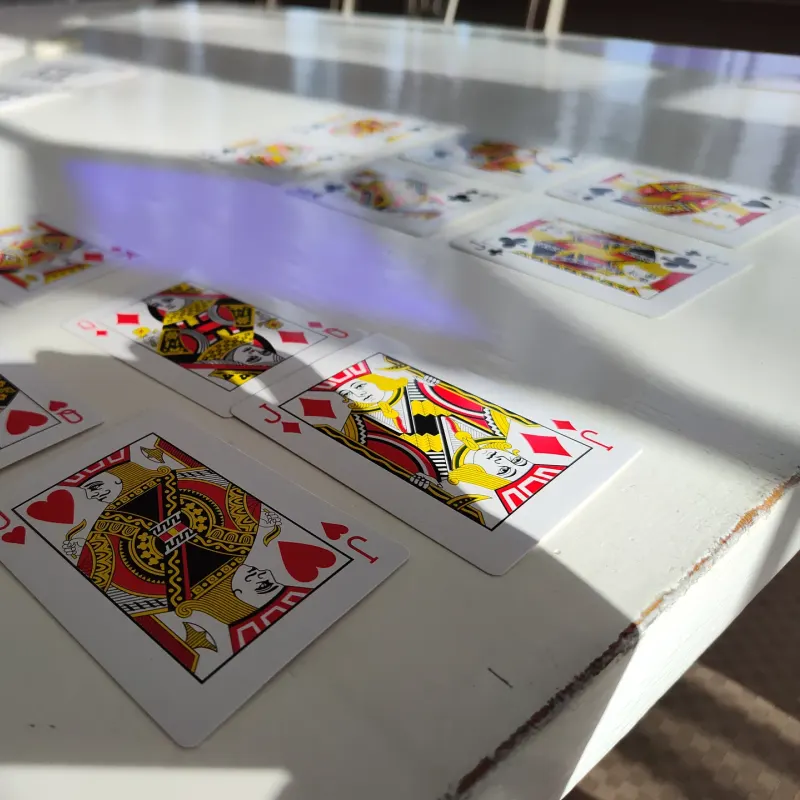
- Step 1
- Take your 13 cards
- Step 2
- Find your strongest five-card hand
- Step 3
- Build the middle hand
- Step 4
- Use the last three cards as the front
- Step 5
- Check the order, then reveal
- Step 6
- Compare each row
How to play pusoy starts with 13 cards that you arrange into three hands: a front of 3 cards, a middle of 5 and a back of 5. Winning comes from setting every card where it earns the most without breaking the order. This page walks you through the set-up, the order of the hands and the scoring.
It sits on the rest of the table games list as the one game where you arrange cards instead of betting on them. The game is a cousin of poker, so the hand names are the ones you already know. The new skill is balance, because one strong hand is worth nothing if it leaves the other two too weak to stay in order.
How to play pusoy in six steps
Follow these in order the first few times. Each step can be done with a real deck on a kitchen table.
- Take your 13 cards from a 52-card deck and sort them by rank.
- Find the strongest five-card hand you can make. This is your back hand.
- From the cards that remain, make the best five-card hand you can without outranking the back. This is your middle hand.
- The last 3 cards are your front hand.
- Check the order: back at least as strong as middle, middle at least as strong as front.
- Reveal and compare front with front, middle with middle and back with back.
An example: with a flush in the back, a straight in the middle and a pair in the front, the order holds, because a flush outranks a straight and a straight outranks a pair.
Chinese poker rules for the three hands
Chinese poker rules are the same ones that govern pusoy, and they come down to hand ranks and the 3-5-5 split. Five-card hands rank as in poker, from weakest to strongest: high card, pair, two pair, three of a kind, straight, flush, full house, four of a kind, straight flush.
The front hand has only three cards, so only three outcomes exist there.
| Hand | Front (3 cards) | Middle and back (5 cards) |
|---|---|---|
| High card | Yes | Yes |
| Pair | Yes | Yes |
| Three of a kind | Yes | Yes |
| Straight, flush | No | Yes |
| Full house, four of a kind | No | Yes |
Rows are never compared across each other. Your front is tested only against an opponent’s front, your middle against their middle and your back against their back.
The 13 card game by the numbers
A 13 card game starts from a large pool of hands.
There are 635,013,559,600 different 13-card hands in a 52-card deck, written C(52,13), and once you hold one you can split it into rows in 72,072 ways. That second figure is C(13,3) × C(10,5) = 286 × 252, so setting the hand is a real decision.
So a rule of thumb helps: build the back and middle first, then check that the three leftover cards form something no stronger than the middle. If they do not, rebalance by moving a card or two.
Fouls, scoring and what to check
Foul means the rows are out of order. Scoring varies, so check the game’s own rules screen for its points.
My back hand is weaker than my middle hand
Swap the two rows. Whichever five-card hand is stronger goes to the back.
My front pair outranks my middle hand
Move a stronger pair or a better five-card combination to the middle, or break the pair in the front.
Scoring a round of pusoy
Most tables give one point for each row you win against an opponent, with a bonus for winning all three rows. Take a ₱10-per-point game as an example. You win front and back and lose the middle against one opponent, so you are up two points minus one, which is one point, or ₱10. The ₱10 stake is a round figure chosen for this example.
| Rows won | Points (one per row) | Result at ₱10 per point |
|---|---|---|
| 3 of 3 | 3, plus any bonus the table adds | At least ₱30 |
| 2 of 3 | 2 won, 1 lost = net 1 | ₱10 |
| 1 of 3 | 1 won, 2 lost = net -1 | -₱10 |
| 0 of 3 | 3 lost = net -3 | -₱30 |
Pusoy vs pusoy dos
Pusoy vs pusoy dos is a question of what you do with the 13 cards.
| Pusoy | Pusoy dos | |
|---|---|---|
| What you do | Set 3, 5 and 5 cards into rows | Play combinations from your hand |
| How a round ends | Rows compared with each opponent | First player to empty their hand |
| Highest rank | Ace | The 2 |
| Cards per player | 13 | 13 |
Suits also behave differently. In most Filipino pusoy dos games, the suit order from low to high is clubs, spades, hearts, diamonds, and it breaks ties between equal ranks. The ordering is covered in card suits order for pusoy dos. If you are new to poker-style hands, the Texas hold em betting rounds show the same hand ranks in a betting game, and a list of ten games puts pusoy beside nine others.
Related guides
- NN777 Baccarat Card Countingbaccarat card counting
- NN777 Card Suitscard suits
- NN777 Five Card Drawfive card draw
- NN777 Hi Lo Card Gamehi lo card game
- NN777 Martingale Baccaratmartingale baccarat
- NN777 Pontoon Card Gamepontoon card game
- NN777 Sic Bo Strategysic bo strategy
- NN777 Texas Hold Emtexas hold em
FAQ
How many cards do you get in pusoy?
13 cards each, from one 52-card deck. You split them 3, 5 and 5 into front, middle and back hands. Every card in your hand ends up in exactly one row.
What happens if I set my hands in the wrong order?
That is a foul, sometimes called a misset. The usual rule is that a fouled hand loses all three rows to every opponent. Check that back is at least as strong as middle, and middle at least as strong as front, before you reveal.
Ano ang pagkakaiba ng pusoy at pusoy dos?
Pusoy sets 13 cards into three hands that are compared row by row. Pusoy dos is a climbing game: you play singles, pairs, triples and five-card hands, and the first to empty their hand wins the round. Ask which one a table means before you join.
How is scoring done in pusoy?
Most tables give one point for each row you win, and add a bonus for winning all three. Scoring variants differ, so read the game's own rules screen for its points.